
How to Play Guitar Solos With More Feeling
How to Play Guitar Solos With More Feeling
One of the most common compliments a guitarist can receive is:
"You play with so much feeling."
It's also one of the most misunderstood.
Many players assume "feeling" is something you're either born with...
...or you aren't.
That's simply not true.
Playing with feeling isn't a mysterious talent.
It's the result of making deliberate musical choices.
In this article, we'll explore what those choices are—and how you can begin making them in your own playing.
Feeling Isn't About Playing More Notes
When guitarists want more expressive solos, they often look for:
- A new scale.
- A new mode.
- A new lick.
But none of those things automatically create emotion.
Think about some of the greatest guitar solos ever recorded.
Many contain surprisingly few notes.
What makes them memorable isn't the quantity of notes.
It's how those notes are played.
Think Like a Singer
If you want your guitar to sound expressive, stop thinking like a guitarist for a moment.
Think like a singer.
Great singers don't race through every lyric.
They pause.
They breathe.
They hold certain notes.
They add emotion through timing and dynamics.
Your guitar can do exactly the same thing.
Don't Rush Every Phrase
One of the easiest ways to lose emotion is by trying to fit too many notes into every bar.
Sometimes the most expressive phrase is the simplest one.
Play a short melody.
Let it breathe.
Allow the listener to absorb it before moving on.
Music needs space.
Make Every Bend Mean Something
Bends are one of the most expressive techniques available to guitarists.
But they're only effective when they have a purpose.
Instead of bending every opportunity you get...
Ask yourself:
"Why am I bending this note?"
Is it building tension?
Creating anticipation?
Reaching an emotional high point?
Every bend should say something.
Vibrato Is Your Voice
Two guitarists can play exactly the same note...
...and sound completely different.
Why?
Because of vibrato.
Your vibrato is part of your musical personality.
Experiment with:
- Wide vibrato.
- Narrow vibrato.
- Fast vibrato.
- Slow vibrato.
Each creates a different emotional effect.
Dynamics Change Everything
Many players pick every note with the same attack.
Instead...
Try telling a story.
Begin softly.
Gradually build intensity.
Then pull back again.
This contrast creates movement and keeps listeners engaged.
Dynamics often have a bigger impact than adding more notes.
Listen Before You Play
One of the biggest reasons solos feel mechanical is because the fingers are leading the music.
Try reversing the process.
Hear the phrase in your head first.
Then play it.
You'll naturally make more musical decisions because your ears are guiding your hands.
Follow the Emotion of the Song
Your solo shouldn't exist in isolation.
Listen to the music underneath you.
A slow, emotional ballad probably doesn't need relentless fast runs.
An energetic rock anthem might welcome more intensity.
Always let the song influence your choices.
Simplicity Is Powerful
Some of the most emotional guitar solos ever recorded are remarkably simple.
They don't rely on endless technical ideas.
They rely on:
- Great phrasing.
- Beautiful timing.
- Strong note choice.
- Confident expression.
Never underestimate the power of simplicity.
Practice Exercise
Choose a slow backing track.
Now create a solo using these rules.
- Play fewer notes than usual.
- Hold notes for longer.
- Focus on vibrato.
- Leave space between phrases.
- Build gradually.
Record yourself.
Ask one question:
"Did I sound like I meant every note?"
If the answer is yes, you're moving in the right direction.
The Play Like A Pro Philosophy
At Play Like A Pro Guitar, I believe expression comes before complexity.
Technical ability is valuable.
But music connects with people through emotion.
That's why every lesson comes back to the same process:
Hear → Understand → Play
Hear the emotion.
Understand how to express it.
Play it with confidence.
When your ears lead your fingers, your solos naturally become more expressive.
Common Mistakes
Playing too many notes
Sometimes fewer notes create more emotion.
Using vibrato on every note
Save it for moments that deserve emphasis.
Ignoring dynamics
Volume changes can transform an otherwise simple phrase.
Thinking only about technique
Technique supports expression.
It isn't the expression itself.
Forgetting to listen
Always react to the music beneath your solo.
Frequently Asked Questions
Can anyone learn to play with feeling?
Yes.
Feeling comes from phrasing, timing, dynamics and musical intention—all of which can be practised.
Do I need advanced techniques?
No.
Many emotional solos are built from simple phrases played with great expression.
Should I practise vibrato?
Absolutely.
Vibrato is one of the most personal and expressive parts of your playing.
Why do professional guitarists sound more expressive?
Because they're thinking about the music they want to create—not simply where their fingers should go next.
Continue Learning
How to Make Your Guitar Solos More Interesting
https://www.playlikeaproguitar.com/blog/how-to-make-guitar-solos-more-interesting
Tension and Release in Guitar Solos: The Secret to More Emotional Improvisation
https://www.playlikeaproguitar.com/blog/tension-and-release-guitar-solos
Why Your Guitar Solos Have No Melody (And How to Fix It)
https://www.playlikeaproguitar.com/blog/why-your-guitar-solos-have-no-melody
How to Build a Guitar Solo That Sounds Musical
https://www.playlikeaproguitar.com/blog/how-to-build-a-guitar-solo
The Complete Guitar Improvisation Learning Path
https://www.playlikeaproguitar.com/blog/guitar-improvisation-learning-path
Ready to Play Solos That Connect With People?
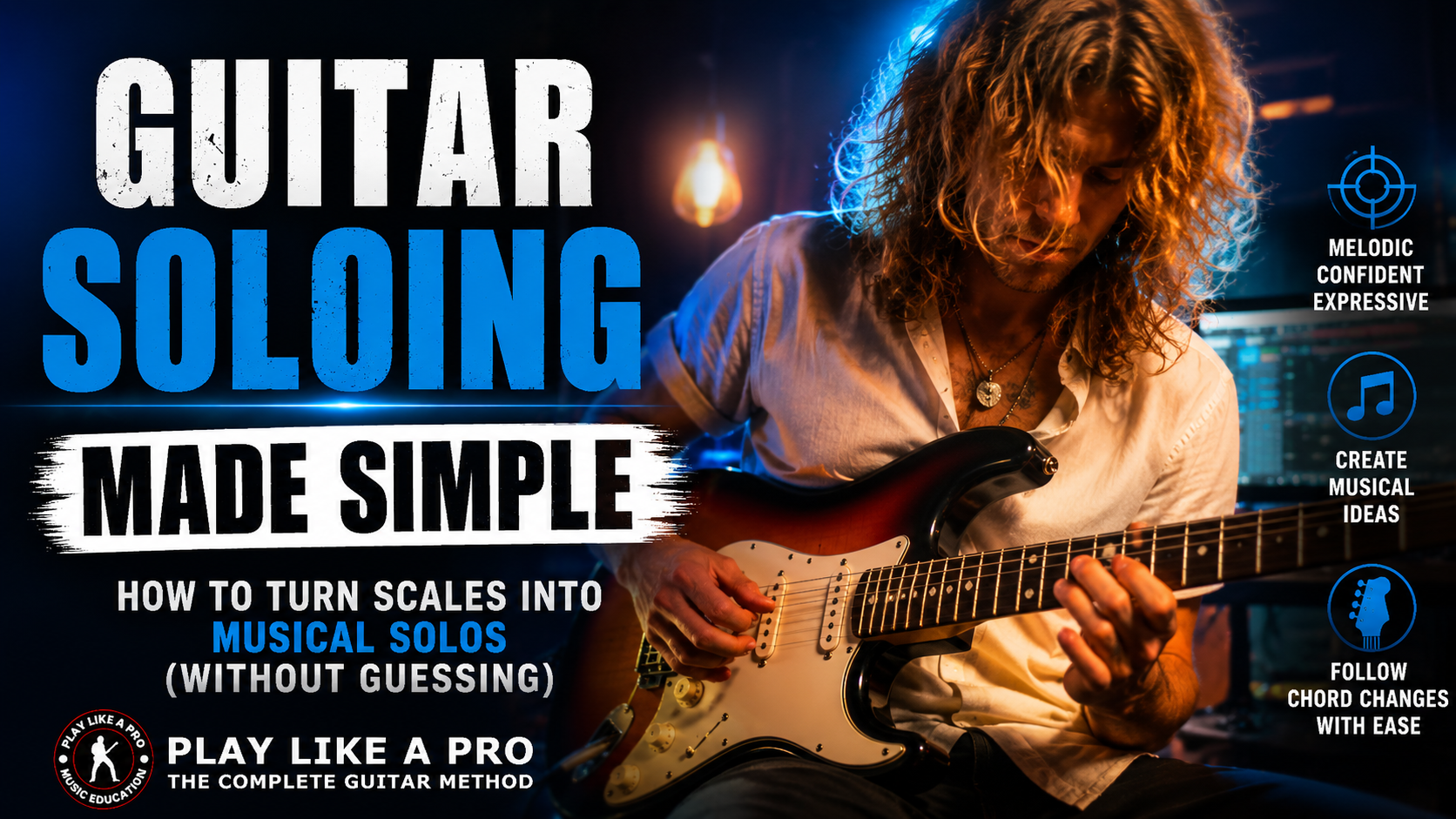
Playing with feeling isn't about finding a secret scale or learning the fastest technique.
It's about making musical decisions that communicate emotion.
Inside Guitar Soloing Made Simple, you'll learn how to combine phrasing, rhythm, ear training, chord awareness and expressive techniques into a complete improvisation system. You'll stop worrying about sounding impressive and start creating solos that genuinely connect with your audience.

