
How to Solo Over Chord Changes Without Getting Lost
How to Solo Over Chord Changes Without Getting Lost
If you've ever put on a backing track and thought...
"I know the scale... but I still don't know what to play..."
You're not alone.
One of the biggest hurdles in guitar improvisation is learning how to follow chord changes.
Most guitarists begin by learning a single scale and using it over an entire progression.
That works surprisingly well.
Until it doesn't.
Eventually, every player reaches a point where they realise:
"My solos all sound the same."
That's usually because the chords underneath are changing...
...but your solo isn't.
The good news is that following chord changes is much easier than most people think.
Do You Have to Change Scale Every Time the Chord Changes?
This is one of the biggest myths in guitar education.
The answer is:
Usually, no.
In many rock, blues and pop songs, one scale will work perfectly well over the whole progression.
The problem isn't the scale.
It's that many players never acknowl...
Chord Tones on Guitar: The Secret to Better Guitar Solos
Chord Tones on Guitar: The Secret to Better Guitar Solos
Have you ever played over a backing track and thought:
"Some notes sound amazing... while others just sound like I'm guessing?"
That's because not every note creates the same feeling.
Some notes feel like they've arrived home.
Others create tension.
Others sound like they want to move somewhere else.
Understanding chord tones is one of the biggest breakthroughs you'll ever make as an improvising guitarist.
It's the difference between simply playing over the music...
...and playing with the music.
What Are Chord Tones?
Every chord is built from a small group of notes.
For example, a simple A minor chord contains:
- A
- C
- E
Those notes are called chord tones.
Whenever that chord is playing, those three notes naturally sound stable and resolved.
That doesn't mean you should only play those notes.
It simply means they become powerful places to begin, finish or emphasise a phrase.
Why Chord Tones Matter
Imagin...
Minor Pentatonic Scale Guitar: The Complete Guide to Using It Musically
Minor Pentatonic Scale Guitar: The Complete Guide to Using It Musically
The minor pentatonic scale is probably the first scale most guitarists ever learn.
It's easy to memorise.
It works over thousands of songs.
And it's used by almost every legendary rock and blues guitarist.
So why do so many players still struggle to improvise?
Because learning the scale is only the beginning.
The real challenge is learning how to use it musically.
In this guide you'll learn not only what the minor pentatonic scale is, but how to transform it from a finger exercise into expressive guitar solos.
What Is the Minor Pentatonic Scale?
The word pentatonic means five notes.
The minor pentatonic scale is built from five notes taken from the natural minor scale.
Because it leaves out two notes that often create stronger tension, it has a smooth, familiar sound that works beautifully across many styles of music.
That's one of the reasons it's so popular with guitarists.
It's forgiving.
Musica...
How to Stop Sounding Like You're Playing Scales
From Scale Practice to Musical Soloing
How to Stop Sounding Like You're Playing Scales
You've learnt the pentatonic scale.
Maybe you've learnt all five positions.
You've memorised a handful of impressive licks.
You put on a backing track...
...and somehow your solo still sounds like you're practising scales.
If you've ever felt that frustration, you're in good company.
In fact, it's probably the single biggest problem guitarists face once they've learnt the basics of improvisation.
The good news?
The problem isn't your scales.
The problem is how you're thinking about them.
Let's fix that.
Scales Aren't Music
This might sound strange coming from a guitar teacher...
But scales aren't music.
They're simply a collection of notes.
Imagine someone handed you every word in the English language.
Would that automatically make you a great storyteller?
Of course not.
The words are important...
But it's how you arrange them that creates meaning.
Sc
...How to Hear Melodies Before You Play Them on Guitar
Guitar Improvisation
How to Hear Melodies Before You Play Them on Guitar
The backing track starts.
Your fingers immediately move into a familiar scale shape.
You play a few notes, add your usual bend and hope that something musical appears.
But what if you reversed that process?
What if you heard the phrase first—and only then found it on the guitar?
That is one of the biggest changes you can make as an improvising guitarist. It is the difference between allowing your fingers to repeat patterns and using the guitar to express a musical idea you can already hear.
The Goal Is Not to Predict Every Note
You do not need to compose an entire solo in your head before playing. Begin by hearing one small phrase, one rhythmic idea or even the direction you want the melody to move.
Why Your Fingers Usually Play First
Most guitarists learn improvisation visually.
You memorise a pentatonic shape.
You practise moving through it.
Eventually, your fingers become very
...How to Know What to Play Next in a Guitar Solo
Guitar Improvisation
How to Know What to Play Next in a Guitar Solo
You play a phrase you really like.
Then your mind goes blank.
Your fingers fall back into the same old lick, run up a scale or stop completely because you have no idea where the solo should go next.
If that sounds familiar, you are not short of talent or creativity.
You probably just need a clearer way to develop the musical ideas you have already played.
You Usually Do Not Need a New Idea
Most guitarists think the next phrase must be completely different. Strong improvisers often do the opposite: they repeat, answer, move or develop the idea they have already introduced.
Why You Run Out of Ideas
Improvisation can feel overwhelming because you appear to have endless choices.
You could play any note in the scale.
Move to another position.
Use a bend, slide, arpeggio or lick.
Follow the chord change.
Or do absolutely nothing.
When your brain tries to compare every possible choice in re
...How to Create Better Guitar Phrases That Sound Musical
Guitar Improvisation
How to Create Better Guitar Phrases That Sound Musical
You know the scale. You can find the right notes. But when you improvise, your solos still sound like a collection of disconnected ideas.
That is usually not a scale problem.
It is a phrasing problem.
A scale gives you the notes you can use. A phrase turns those notes into something that sounds like music.
In this guide, you will learn how to create stronger guitar phrases using rhythm, repetition, space, melody and musical development—without needing to learn another scale.
The Difference Between Notes and Phrases
Notes are the vocabulary. Phrases are the sentences. Improvisation begins to sound musical when your notes feel connected, intentional and directed towards a clear destination.
What Is a Guitar Phrase?
A guitar phrase is a short musical idea.
It might contain only three or four notes. What makes it feel complete is not its length, but the way those notes work together.
The Pentatonic Scale Explained: How to Turn Scales Into Musical Guitar Solos
From Scale Shapes to Musical Solos
The Pentatonic Scale Explained: How to Turn Scales Into Musical Guitar Solos
Ask almost any guitarist what scale they learnt first...
...and they'll probably say the minor pentatonic scale.
For good reason.
It's Simple
It's Versatile
It's Everywhere
It's been used in thousands of incredible guitar solos.
But here's the problem...
Most guitarists learn the pentatonic scale and then have absolutely no idea what to do with it.
They memorise the shape.
They can play it up and down.
But when it's time to improvise...
They freeze.
If that sounds familiar, the scale isn't the problem.
The problem is nobody showed you how to turn it into music.
That's exactly what this guide is about.
What Is the Pentatonic Scale?
The word pentatonic simply means five notes.
Pentatonic Scale
5 Notes
A stripped-back collection of notes that's incredibly useful for improvisation.
Major & Minor Scales
7 Notes
T
...Guitar Phrasing: How to Make Your Guitar Solos Sound Musical
Stop Playing Scales. Start Making Music.
Guitar Phrasing: How to Make Your Guitar Solos Sound Musical
Have you ever listened to two guitarists play exactly the same scale...
...yet one sounds like they're making music while the other sounds like they're practising?
The difference usually isn't technique.
It isn't speed.
It isn't even the notes they're playing.
The difference is...
Phrasing.
Phrasing is what transforms a collection of notes into a musical conversation.
It's what makes players like David Gilmour, B.B. King and Eric Clapton instantly recognisable—even when they're playing relatively simple ideas.
If you've ever thought...
“My solos sound like scales.”
“I know the right notes but they don't sound musical.”
“I want my solos to have more emotion.”
Then improving your phrasing is one of the biggest steps you can take.
What Is Guitar Phrasing?
Think about someone telling a story.
They Pause
They Emphasise
They Speed Up
T
...How to Play What You Hear on Guitar (The Missing Link in Guitar Improvisation)
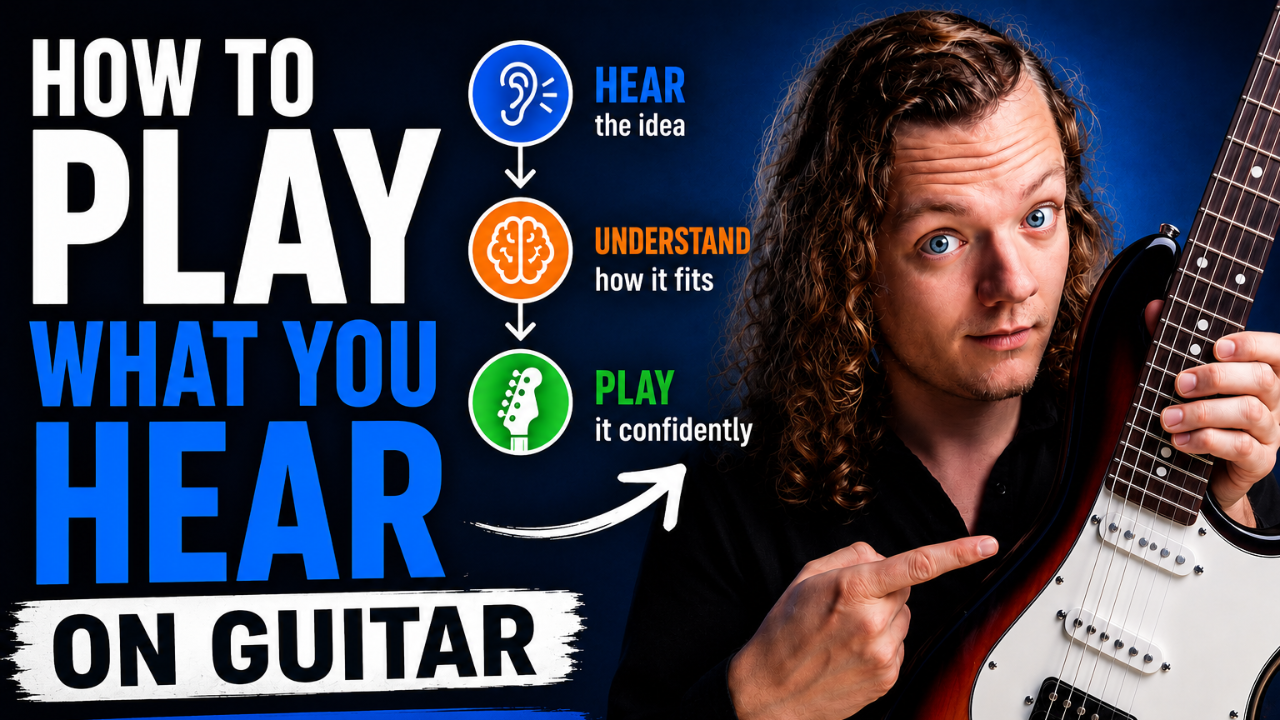
Train Your Ears. Free Your Playing.
How to Play What You Hear on Guitar
If I asked you to sing a simple melody right now...
Maybe it's the chorus of your favourite song.
Maybe it's a blues lick you've heard a hundred times.
Maybe it's a melody you've just made up.
Now here's the real question:
Could you immediately play that same melody on your guitar?
For most guitarists, the answer is no.
And that's one of the biggest reasons improvisation feels so difficult.
You Don't Lack Ideas
You lack the connection between your ears and your fingers.
The good news? That connection can be trained.
The Biggest Frustration I Hear From Guitar Players
When students first join my courses, they often tell me things like:
“I can hear solos in my head, but I can't get them onto the guitar.”
“I know scales, but I don't know how to make them sound musical.”
“I've got ideas, but by the time I find the notes, the idea has disappeared.”

