
How to Play What You Hear on Guitar (The Missing Link in Guitar Improvisation)
Train Your Ears. Free Your Playing.
How to Play What You Hear on Guitar
If I asked you to sing a simple melody right now...
Maybe it's the chorus of your favourite song.
Maybe it's a blues lick you've heard a hundred times.
Maybe it's a melody you've just made up.
Now here's the real question:
Could you immediately play that same melody on your guitar?
For most guitarists, the answer is no.
And that's one of the biggest reasons improvisation feels so difficult.
You Don't Lack Ideas
You lack the connection between your ears and your fingers.
The good news? That connection can be trained.
The Biggest Frustration I Hear From Guitar Players
When students first join my courses, they often tell me things like:
“I can hear solos in my head, but I can't get them onto the guitar.”
“I know scales, but I don't know how to make them sound musical.”
“I've got ideas, but by the time I find the notes, the idea has disappeared.”
These Aren't Theory Problems
They're communication problems.
Your brain is already hearing music. Your fingers just haven't learned the language yet.
Why This Happens
Most guitar education starts with shapes.
Scale Patterns
Chord Shapes
Arpeggios
Modes
Those things are important.
But very little time is spent developing your ears.
Pattern Training
Become good at remembering where your fingers are supposed to go.
Ear Training
Become good at recognising sounds and finding them on your instrument.
The Result
Many guitarists become excellent at copying patterns but struggle when they try to express their own musical ideas.
Great Improvisers Don't Guess
When you watch an experienced improviser, it can look like they're magically choosing the right notes.
They're not guessing.
They're reacting to what they hear.
Their ears guide their fingers. That's a completely different mindset from constantly thinking about scale shapes.
Pattern-First
“Which scale shape am I in?”
Sound-First
“I can hear where this phrase wants to go.”
That's the Goal
Your fingers still need technical knowledge. But eventually, your ears should be the thing deciding where the music goes next.
The Difference Between Hearing and Listening
Most people hear music.
Very few actively listen.
Listening means paying attention to what's actually happening inside the music.
The Melody
Listen to the shape of the phrase and whether the notes move higher, lower or stay around the same area.
The Rhythm
Notice when each note happens, where the gaps appear and which notes are emphasised.
The Beginning
Pay attention to where the phrase enters rather than assuming everything starts on beat one.
The Resolution
Listen for the moment the phrase feels finished or arrives somewhere musically satisfying.
The Chords Underneath
Listen to how the melody interacts with the harmony and how certain notes feel different as the chords change.
Listening Is a Skill
The better you become at actively listening to these details, the easier it becomes to recognise and recreate musical ideas on your guitar.
Start With Simple Melodies
One of the biggest mistakes players make is trying to work out complicated solos straight away.
Don't start with Eric Johnson.
Don't start with Guthrie Govan.
Start with something you could sing after hearing it once.
Nursery Rhymes
TV Themes
Happy Birthday
Vocal Melodies
If you can sing it...
You can learn to find it.
Sing Before You Play
This is one of the most powerful exercises you can do.
Instead of immediately reaching for your guitar, sing a short phrase first.
STEP 1
Hear an Idea
STEP 2
Sing the Phrase
STEP 3
Find the Notes
STEP 4
Play the Phrase
Don't worry if it takes time to find the notes.
The Goal Isn't Speed
The goal is building the connection between what you hear and where those sounds live on the fretboard.
Over time, that connection becomes faster and more instinctive.
Limit Yourself on Purpose
Most players think more notes equal more creativity.
But when you're learning to improvise...
The opposite is often true.
Choose just three notes.
Now create as many musical ideas as you can.
Change the Rhythm
Keep the notes but change when you play them.
Leave More Space
Allow phrases to breathe instead of filling every gap.
Change the Dynamics
Experiment with softer and stronger attacks.
Repeat an Idea
Turn one small phrase into something memorable through repetition.
Why This Works
You'll quickly discover that rhythm, phrasing and dynamics matter far more than playing lots of notes. Limiting your options forces you to stop relying on patterns and start listening.
Learn Songs Without TAB
TAB is incredibly useful.
But if you rely on it for everything, your ears never get stronger.
A Simple Melody
Pick something easy enough to sing and work it out one note at a time.
A Favourite Riff
Listen carefully to the rhythm and contour before searching for notes.
A Vocal Line
Copy a short sung phrase and try to match the shape of the melody.
A Blues Phrase
Start with something short and expressive rather than technically difficult.
Slow Is Normal
At first, working things out by ear can feel painfully slow. That's completely normal. Every note you find yourself is strengthening your musical hearing.
Use Backing Tracks Differently
Most players switch on a backing track and immediately start running scales.
Instead, try this:
Play one note.
Does It Feel Resolved?
Listen for whether the note feels settled or complete against the chord.
Does It Create Tension?
Notice when a note feels unstable or seems to want to move somewhere else.
Move Up One Fret
Compare how the emotional quality changes against the harmony.
Move Down One Fret
Listen again and notice which direction feels more musical.
Listen Before You Move
This simple experiment teaches you more about how notes actually function over harmony than mindlessly running patterns ever will.
Record Yourself Singing
Here's an exercise that almost nobody does.
Open your phone and record yourself singing a short melody.
STEP 1
Sing 4–5 Notes
STEP 2
Record It
STEP 3
Pick Up the Guitar
STEP 4
Copy It Exactly
Why This Exercise Is So Powerful
The melody came from you. You're not copying a tab, a teacher or another guitarist. You're training your fingers to reproduce a musical idea that already existed in your own head.
Be Patient
Learning to play what you hear isn't something that happens overnight.
It's a lifelong skill.
But every time you do one of these things, you're strengthening the connection:
Sing Before Playing
Learn a Melody by Ear
Copy a Phrase Without TAB
Listen Carefully to a Solo
Eventually, something amazing happens.
You stop searching for notes.
You hear an idea... and your fingers know where to go.
One of the Most Rewarding Breakthroughs
That moment is when improvisation starts to feel less like searching around the fretboard and more like genuinely expressing yourself through the instrument.
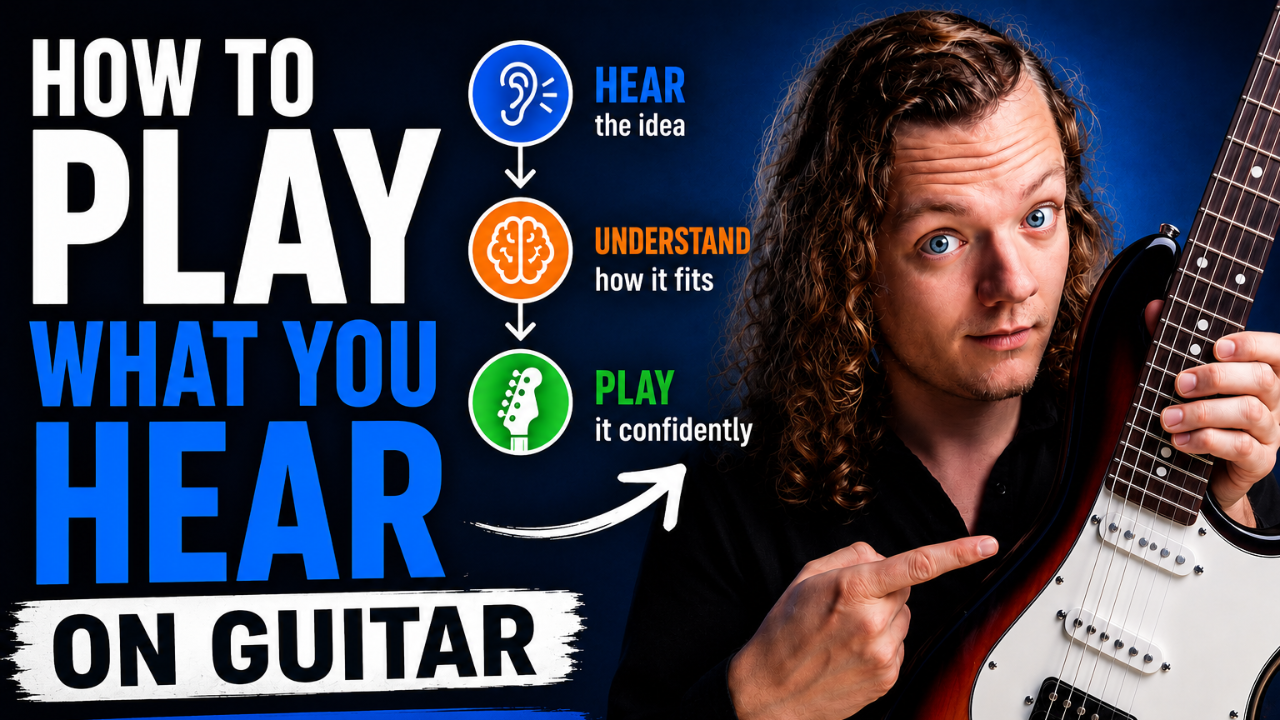
The Play Like A Pro Philosophy
At Play Like A Pro Guitar, I believe improvisation begins with your ears—not your fingers.
That's why I teach students to follow one simple process.
Hear
Hear the musical idea clearly.
Understand
Understand how it fits with the harmony.
Play
Play it confidently on the guitar.
Hear → Understand → Play
The stronger this connection becomes, the less dependent you'll be on memorised patterns and the more naturally you'll improvise.
Five Exercises to Start Today
You don't need a complicated ear-training routine. Start with these five simple habits.
1. Sing a phrase before every solo.
2. Learn one simple melody by ear each week.
3. Improvise using only three notes.
4. Record yourself and copy your own ideas.
5. Spend five minutes listening before playing.
Do These Consistently
And you'll gradually notice your improvisation becoming more natural, more melodic and far less dependent on memorised scale shapes.
Frequently Asked Questions
Is Playing by Ear the Same as Improvisation?
Not exactly. Playing by ear is the ability to recognise and reproduce sounds. Improvisation is the ability to create new musical ideas in real time. The two skills strongly support each other.
Can Ear Training Really Improve My Solos?
Absolutely. The better your ears become, the easier it is to create phrases that sound intentional rather than relying on memorised scale patterns.
Do I Need Perfect Pitch?
No. Most great guitarists don't have perfect pitch. What matters is developing strong relative pitch, which is the ability to recognise the relationship between notes. That can be improved with practice.
How Long Does It Take to Improve?
You'll often notice improvements within a few weeks of consistent practice, but developing a strong connection between your ears and your guitar is an ongoing journey.
Continue Learning
Your next steps:
The Ultimate Guide to Guitar Improvisation
Explore the complete roadmap from beginner concepts through to more advanced improvisation.
Read Guide →How to Improvise on Guitar
Follow a practical step-by-step system for creating more expressive solos.
Read Guide →Why Most Guitarists Can't Improvise
Discover why learning more scales often doesn't solve the real problem.
Read Guide →Guitar Phrasing Guide
Learn how rhythm, repetition and space turn simple notes into expressive phrases.
Read Guide →Pentatonic Scale Guide
Master the scale behind countless blues, rock and modern guitar solos.
Read Guide →Ready for the Next Step?
Ready to Finally Play the Solos You Hear in Your Head?

If you've ever felt like the music is already in your head but your fingers can't keep up, you're exactly who Guitar Soloing Made Simple was created for.
Inside the course, you'll learn a structured, practical approach to turning scales into musical phrases, connecting your ears to the fretboard, following chord changes and improvising with confidence.
Stop guessing. Start expressing the ideas you already hear.

