
The Improvisation Pyramid: The 7 Skills Every Great Guitar Improviser Needs
The Improvisation Pyramid: The 7 Skills Every Great Guitar Improviser Needs
One of the biggest mistakes guitarists make is believing there's one thing they need to improve.
"If I learn modes, I'll become a better improviser."
"If I memorise the fretboard, I'll finally sound musical."
"If I learn more scales, everything will click."
The reality is very different.
Great improvisation isn't built on one skill.
It's built on several skills working together.
That's why I teach what I call The Improvisation Pyramid.
It's a simple framework that explains why some guitarists know hundreds of scales but still struggle to improvise...
...while others create beautiful, expressive solos using only a handful of notes.
Let's build it from the ground up.
Level 1 — Rhythm
Everything starts here.
Before scales.
Before theory.
Before modes.
There is rhythm.
Think about your favourite guitarists.
Even if they only played one note, you'd probably recognise many of them by their timing alone.
Rhythm creates movement.
Personality.
Groove.
Without rhythm, even the perfect note sounds lifeless.
If you only improve one thing this month...
Improve your rhythm.
Level 2 — Phrasing
Now we begin turning notes into sentences.
Phrasing is how you organise musical ideas.
It's where you learn to:
- Leave space.
- Repeat ideas.
- Build conversations.
- Shape melodies.
This is where your solos stop sounding like exercises and start sounding like music.
Level 3 — Melody
At this level, you stop asking:
"What notes fit?"
And start asking:
"What melody do I hear?"
This is where improvisation becomes memorable.
People rarely walk away humming scales.
They remember melodies.
The best guitar solos are almost always singable.
Level 4 — Fretboard Freedom
Now your ideas need somewhere to go.
Fretboard freedom isn't about knowing every note instantly.
It's about being able to follow your musical ideas without constantly running into dead ends.
The more confidently you navigate the neck, the easier it becomes to express what you hear.
Level 5 — Harmony
This is where many solos suddenly become much more connected.
Instead of playing over the chords...
You begin playing with them.
Chord tones.
Arpeggios.
Target notes.
Voice leading.
Harmony gives your melodies direction.
Level 6 — Musical Colour
Only now do we begin exploring richer colours.
Modes.
Modal interchange.
Harmonic minor.
Diminished ideas.
Chromaticism.
Notice something important.
These aren't the foundation.
They're decoration.
Many guitarists start here.
The strongest improvisers arrive here after mastering everything underneath.
Level 7 — Musical Expression
At the top of the pyramid sits something no scale can teach.
Expression.
This is where technique disappears.
Theory becomes invisible.
Your ears, hands and imagination work together naturally.
You're no longer thinking about scales.
You're simply making music.
Ironically...
This is the level many beginners try to skip to immediately.
The truth is that expression grows naturally as the lower levels become stronger.
Why Most Guitarists Get Stuck
Here's the problem.
Most players build their pyramid upside down.
They start here:
- Modes.
- Advanced scales.
- Exotic theory.
Meanwhile the foundations remain weak.
Their rhythm hasn't developed.
Their phrasing lacks direction.
Their melodies aren't memorable.
So despite knowing more information...
Their solos don't improve.
It's like trying to build the roof of a house before laying the foundations.
Where Are You Right Now?
Ask yourself honestly.
Which level needs the most attention?
Maybe your rhythm is solid...
But your phrasing needs work.
Perhaps your fretboard knowledge is excellent...
But you struggle to hear melodies.
The goal isn't to race to the top.
It's to strengthen whichever layer is currently weakest.
Because every level supports the ones above it.
The Play Like A Pro Philosophy
Everything I teach fits somewhere inside this pyramid.
Scales matter.
Theory matters.
Technique matters.
But none of them exist in isolation.
The goal isn't to master separate skills.
It's to connect them.
That's why every lesson follows the same process:
Hear → Understand → Play
Hear the musical idea.
Understand why it works.
Play it naturally.
That's the journey from the bottom of the pyramid to the top.
Practice Challenge
Draw the pyramid on a piece of paper.
Score yourself out of ten in each area:
- Rhythm
- Phrasing
- Melody
- Fretboard Freedom
- Harmony
- Musical Colour
- Expression
Don't worry about getting a perfect score.
Simply identify the weakest layer.
Spend the next month improving that one area.
You'll probably notice improvements throughout your entire playing.
Frequently Asked Questions
What's the most important skill for guitar improvisation?
Rhythm is the foundation. Without strong rhythm, every other skill becomes much harder to use musically.
Should I learn modes before chord tones?
Generally, no. Chord tones help you connect to the harmony, while modes add colour once that foundation is in place.
Can beginners use the Improvisation Pyramid?
Absolutely. In fact, it helps beginners focus on the right skills in the right order instead of feeling overwhelmed.
Is this a practice system?
It's better thought of as a roadmap. It helps you identify which skills deserve your attention and how they all connect.
Continue Learning
The Ultimate Guide to Guitar Improvisation
https://www.playlikeaproguitar.com/blog/guitar-improvisation
The Complete Guitar Improvisation Learning Path
https://www.playlikeaproguitar.com/blog/guitar-improvisation-learning-path
How to Think Like an Improviser (Instead of Just Playing Scales)
https://www.playlikeaproguitar.com/blog/how-to-think-like-an-improviser
13 Ways to Instantly Sound More Musical on Guitar
https://www.playlikeaproguitar.com/blog/how-to-sound-more-musical-on-guitar
15 Guitar Soloing Mistakes That Are Holding You Back (And How to Fix Them)
https://www.playlikeaproguitar.com/blog/guitar-soloing-mistakes
Ready to Build Your Improvisation From the Ground Up?
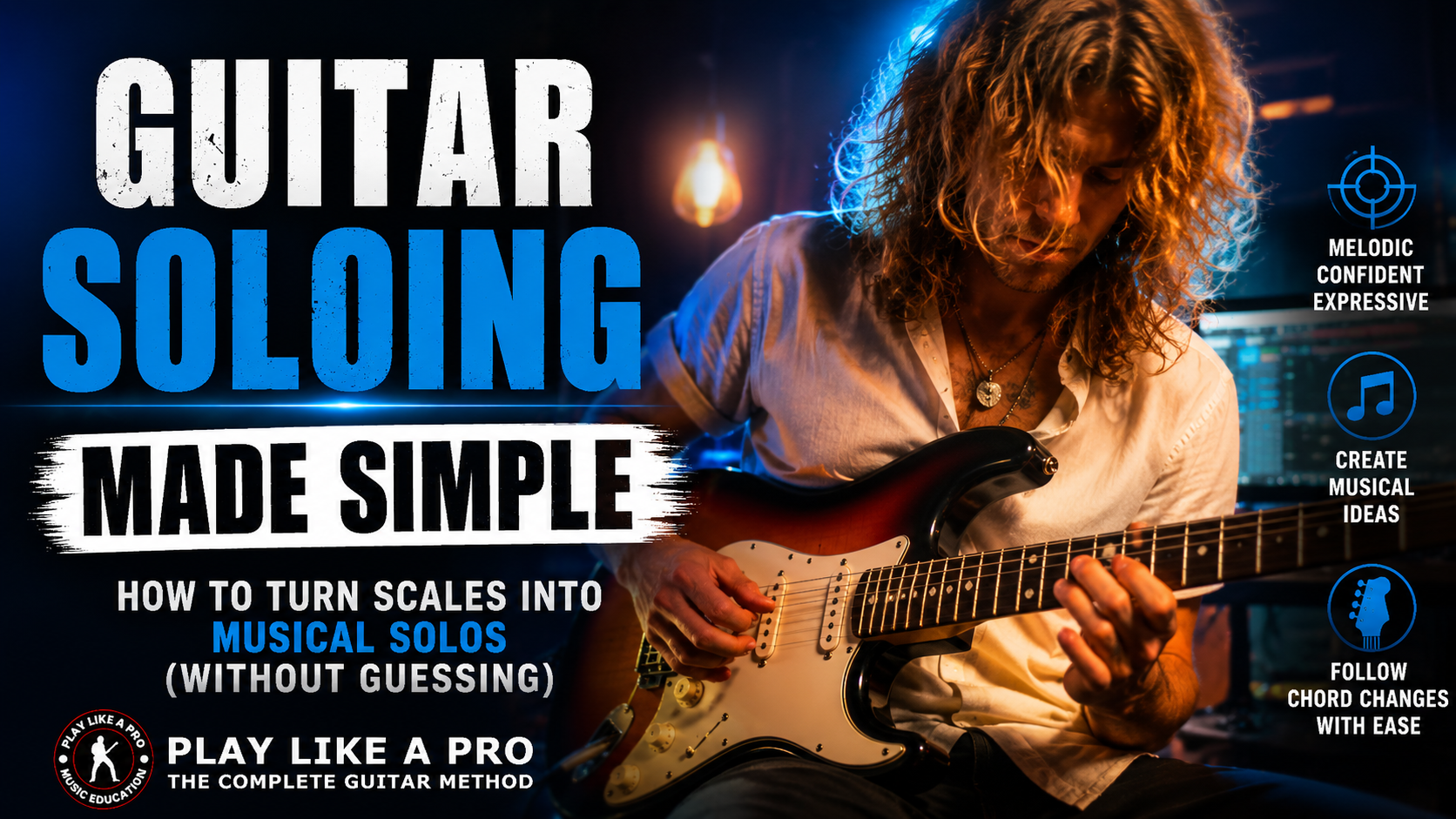
Improvisation isn't one skill.
It's the combination of rhythm, phrasing, melody, fretboard knowledge, harmony, musical colour and expression working together.
Inside Guitar Soloing Made Simple, you'll build every layer of the Improvisation Pyramid step by step, following a structured roadmap that takes you from your first improvised phrases to confident, expressive soloing across the entire fretboard.
Instead of wondering what to learn next, you'll always know exactly which layer of the pyramid to strengthen.

