
Relative Pitch for Guitarists: The Skill That Makes Improvisation Easier
Relative Pitch for Guitarists: The Skill That Makes Improvisation Easier
Ask a room full of guitarists what they need to become better improvisers and you'll hear answers like:
"I need to learn more scales."
"I should study modes."
"I probably need more theory."
Very few people say:
"I need a better ear."
And yet...
Your ears are the part of your musicianship making every musical decision.
If your ears improve, your improvisation improves.
That's why relative pitch is one of the most valuable skills any guitarist can develop.
What Is Relative Pitch?
You don't need perfect pitch to become a great improviser.
In fact...
Most professional musicians don't have perfect pitch.
What they do have is excellent relative pitch.
Relative pitch is simply the ability to recognise how one note relates to another.
Can you hear when a melody moves up?
Can you hear when it comes back down?
Can you recognise whether a note feels finished or unresolved?
That's relative pitch.
It's one of the foundations of musical freedom.
Why Relative Pitch Matters
Imagine trying to have a conversation in a foreign language by memorising hundreds of sentences.
You might survive...
But you'd struggle to express yourself naturally.
Improvisation works the same way.
When your ears recognise musical relationships, you stop relying entirely on memory.
Instead of recalling information...
You begin making musical decisions.
The Biggest Myth About Ear Training
Many guitarists believe ear training is something you're either born with or you aren't.
That's simply not true.
Your ears improve the same way your fingers improve.
Through consistent practice.
Every time you:
- Learn a melody by ear.
- Copy a phrase.
- Sing before playing.
- Listen carefully to harmony.
Your relative pitch gets a little stronger.
Start With Small Movements
Don't try recognising complicated jazz melodies immediately.
Begin with simple musical ideas.
Can you hear when one note is higher than another?
Can you recognise a familiar nursery rhyme?
Can you copy a two-note phrase?
Small victories build powerful ears.
Sing More
This might feel uncomfortable at first.
Do it anyway.
Singing forces your brain to hear notes before your fingers search for them.
Even if you don't think you're a good singer...
The exercise still works.
Remember...
You're training your ears.
Not performing on stage.
Use the Guitar as a Tool
Many players think the guitar teaches their ears.
Actually...
Your ears should be teaching your guitar.
Hear a note.
Then find it.
Not the other way around.
This tiny shift changes everything.
Don't Rush
Ear training is different from learning scale patterns.
There's no shortcut.
But there is good news.
The improvements compound.
Every exercise makes the next one slightly easier.
Six months from now you'll hear things that seem completely invisible today.
Relative Pitch Helps Everything
As your ears improve, you'll notice changes in every area of your playing.
You'll begin:
- Learning songs faster.
- Following chord changes more naturally.
- Creating stronger melodies.
- Recovering from mistakes more easily.
- Improvising with greater confidence.
That's why ear training isn't a separate skill.
It supports everything else.
Practice Exercise
Spend ten minutes each day doing this.
- Hum a short phrase.
- Find it on the guitar.
- Repeat it.
- Change one note.
- Listen to how the emotion changes.
This simple habit builds the connection between your ears and your fingers.
The Play Like A Pro Philosophy
At Play Like A Pro Guitar, I believe your ears should always be leading your hands.
Improvisation isn't about remembering information.
It's about recognising sounds.
That's why every lesson follows the same path:
Hear → Understand → Play
Hear the idea.
Understand what you're hearing.
Play it confidently.
When your ears improve, everything else becomes easier.
Common Mistakes
Waiting until you're "good enough"
Ear training should begin from day one.
Thinking you need perfect pitch
You don't.
Relative pitch is far more useful for improvisation.
Only using TAB
Balance visual learning with listening exercises.
Getting frustrated
Ear training develops gradually.
Celebrate small improvements.
Frequently Asked Questions
Is relative pitch better than perfect pitch?
For improvisation, relative pitch is often more practical because it helps you understand how notes relate to one another.
Can adults improve their ears?
Absolutely.
Ear training is a skill that improves with consistent practice regardless of age.
How long should I practise ear training?
Even ten focused minutes each day can make a noticeable difference over time.
Do I need expensive ear training software?
No.
Your voice, your guitar and careful listening are enough to make significant progress.
Continue Learning
How to Turn Ideas in Your Head Into Guitar Solos
https://www.playlikeaproguitar.com/blog/turn-ideas-into-guitar-solos
How to Play What You Hear on Guitar
https://www.playlikeaproguitar.com/blog/how-to-play-what-you-hear-on-guitar
How to Practice Guitar Improvisation (A Step-by-Step Practice Routine)
https://www.playlikeaproguitar.com/blog/how-to-practice-guitar-improvisation
Why Do I Freeze When Improvising on Guitar?
https://www.playlikeaproguitar.com/blog/why-do-i-freeze-when-improvising
The Complete Guitar Improvisation Learning Path
https://www.playlikeaproguitar.com/blog/guitar-improvisation-learning-path
Ready to Trust Your Ears Instead of Guessing?
The best improvisers don't rely on luck.
They rely on well-trained ears.
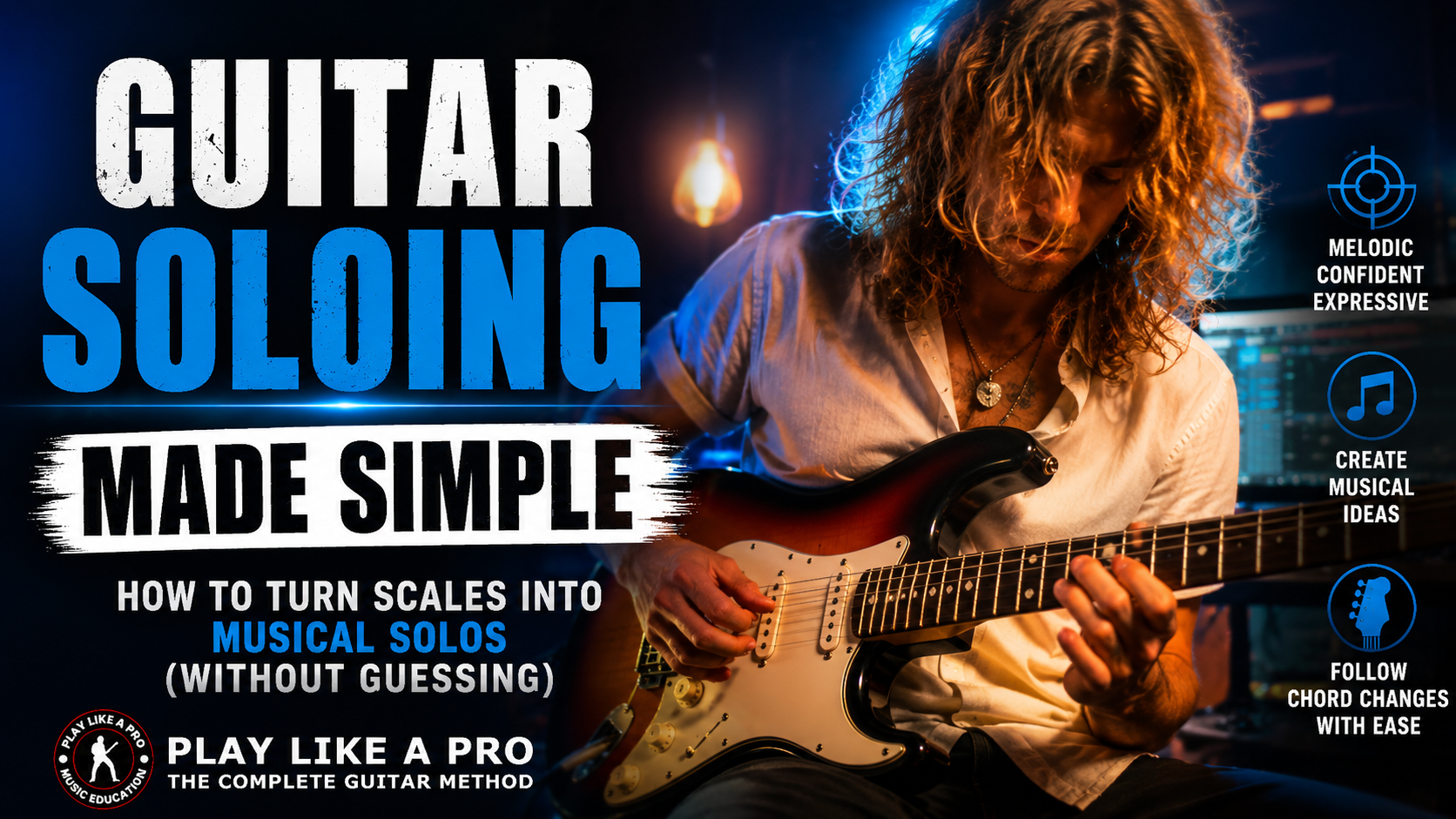
Inside Guitar Soloing Made Simple, you'll develop practical ear-training skills alongside scales, phrasing, chord tones and fretboard knowledge. You'll learn how to hear musical ideas, understand them and express them confidently on the guitar.
Because when your ears improve, improvisation stops feeling like guesswork—and starts feeling like music.

